
“I've had the opportunity to work with Larry and Fusion Payments and the experience has been great for my small business. Providing a simple mobile solution that allows me to make changes on the go and provide a great experience for my customers.”
Service & trades
You just closed a $12,000 fence job. Card fees shouldn't take $348 of it.
Fusion Payments builds credit card processing for invoice-driven trades: take the deposit by text the day the proposal is signed, run draws on a card on file, send a final invoice that pays in one tap — and see the fee math up front, before you sign anything.
- fencing
- roofing
- HVAC
- plumbing
- electrical
- landscaping
The review is free · bring last month's statement
Fusion Payments — The fee math
Figures illustrative*
You never see the fee as one number. So you never fight it.
Three percent of a service call is lunch money. Three percent of a fence is real money — and it posts one quiet line at a time, twelve months a year. Add it up and it is a number worth fighting.
One job, as it posts Invoiced 04/17 · paid by card
Job 2114 — 210 ft cedar privacy fence
- Invoice total
- $12,000.00
- Card fee — 2.9% + 30¢, blended
- − $348.30
- Deposited next business day
- $11,651.70
What that line costs in a year
- One job
- $348.30
- A month — three jobs
- $1,044.90
A year, at that pace
$12,538.80
equivalent: the thirteenth fence — built, invoiced, and paid to the processor
The other way to run it
Dual pricing posts a cash price and a card price.
The card price carries the cost of acceptance; the deposit that reaches you is the price you set — on card volume, your processing fee goes to zero. It is a different mechanism from surcharging, and it is priced against your own statement, not a brochure.
Read the worked ticket* Figures illustrative — one representative job at a 2.9% + 30¢ blend. Your rate, card mix, and debit share differ, and fixed monthly fees are not shown. Bring a statement; we total yours line by line.
Where the money moves
Four moments a job pays. None of them at a desk.
The same rail that runs the website runs the money — no office stop between the signature and the deposit.
-
At signing
01 The deposit, the day they say yes
The proposal is signed at the kitchen table and the deposit request is on the customer's phone before you're back in the truck. Text or email — they pay from the message.
moves: 30% deposit · text-to-pay · no portal, no login
-
Mid-job
02 Draws on the card on file
The card is tokenized at the deposit. Progress draws charge it on the schedule the contract sets — no chasing, no re-keying, no card number in a drawer.
card on file: tokenized at deposit · charged per draw
-
Punch list cleared
03 The final invoice is a link
Itemized, matching the proposal, payable in one tap. The customer keeps the receipt; the ledger keeps the match.
link: final invoice · itemized · pays in one tap
-
Next morning
04 Funding, next business day
Yesterday's batch is in the account before the crew loads. Not a reserve, not a rolling hold — the money, on schedule.
settles: prior-day batch · next business day
* The deposit and the draw schedule are yours to set — the rail doesn't care if it's 30/40/30 or 50/50.
Fusion Payments — The other practice
Your website, handled.
Fusion Payments builds and hosts the sites its payment stacks run behind — one vendor, one accountable team, from the first visit to the deposit. If yours is due for a rebuild anyway, ask about the website program.
See the web practice
terms: asked for, not posted — priced alongside your statement reading
The job site
The counter is a tailgate. The stack is built for it.
-
Tap to pay in the driveway
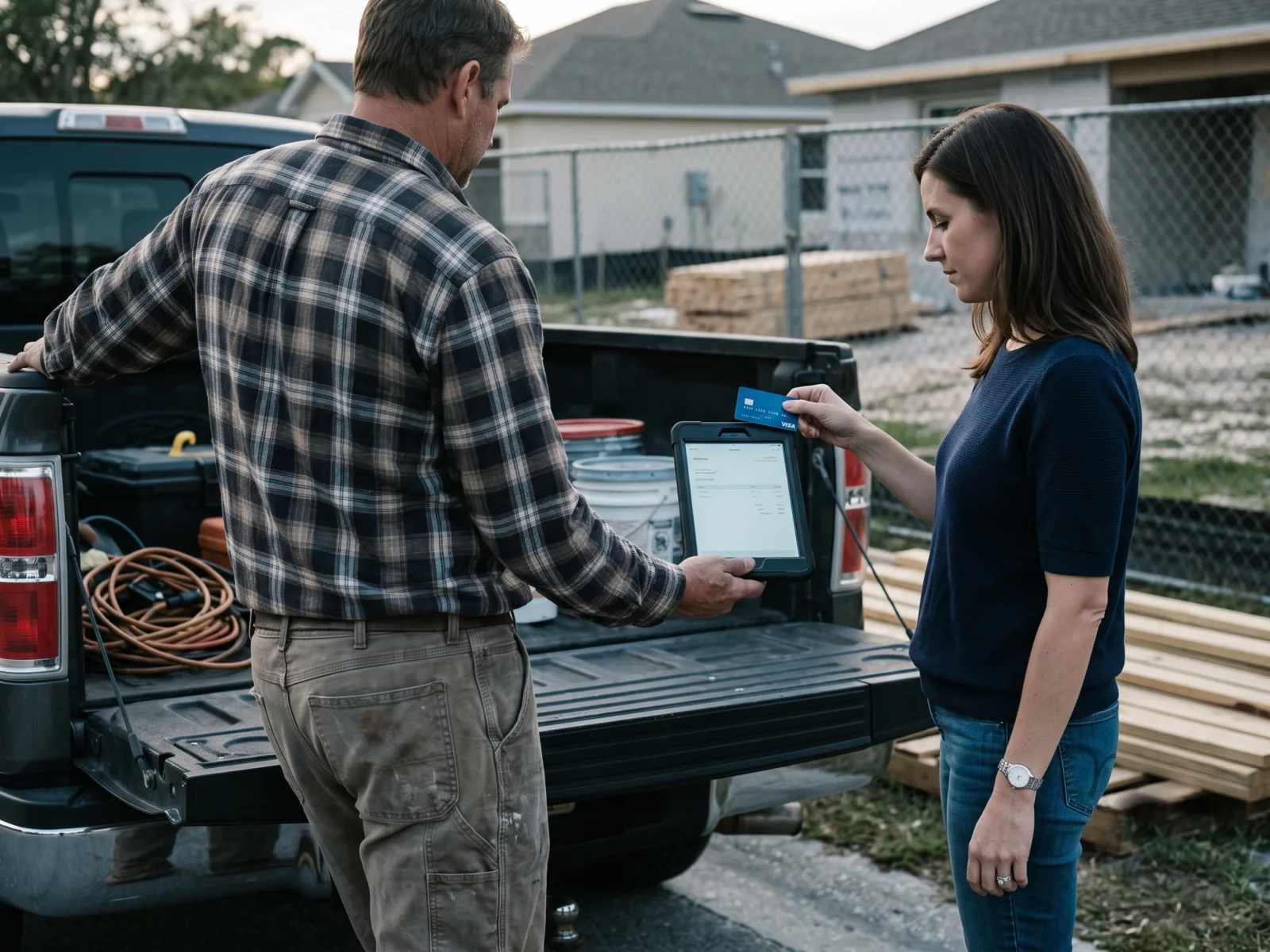
The final walkthrough ends with a tap — on a pocket reader or the phone already in your hand. No hardware the crew has to babysit.
hardware: pocket reader · or the phone itself
-
Invoice from the cab
Wrap the site, send the invoice before pulling away. It arrives while the work is still the newest thing in the customer's day — which is when invoices get paid.
sent: from the truck · before the next job
-
Every payment lands in a report you can read
Texted deposits and invoice links post to one transactions report. Driveway taps on the terminal settle in the batches report. Both match the deposit that reaches the bank.
posts: two reports · txn ↔ deposit
Fusion Payments — From the record
Source: Google · Reproduced verbatim
On working from the road, and on picking up the phone.
“Great customer service, quick response and if the answer is not known then questions are asked to get to the bottom of the issue. We have been pleased with the service received.”
extract: 02 of 07 on record · uncompensated, unedited
The complete recordFusion Payments — Questions from the trades
Asked from the truck. Answered plainly.
Five questions contractors ask about credit card processing, answered the way we answer them on the phone.
- Index
- 05 questions
- Revision
- 2026-08
- Asked of
- A person, first
IDQuestion
Q-01Can I take a deposit before the job starts?
Yes. Fusion Payments sends a deposit request by text or email the moment the proposal is signed, and the customer pays it from their phone — no portal, no account. The card is tokenized at that first payment, so progress draws and the final invoice can charge it on the schedule your contract sets.
see: How invoicing works
Q-02What does the card fee on a $10,000 invoice actually cost?
At a typical blended rate near three percent, about $300 — per invoice, every invoice. Fusion Payments totals that line across a year of your real volume during a statement review, because the honest number is the annual one, and it is almost always larger than the owner guessed.
Q-03Do my customers have to pay the card price?
No — under dual pricing every customer sees a cash price and a card price and chooses. Cash and check take the cash price; any card, debit included, pays the posted card price. It is a different mechanism from surcharging, and Fusion Payments configures the signage and receipt language for your state before it goes live.
see: Dual pricing, worked
Q-04What if I already have a website?
Keep it — the payment stack does not require our web practice. But most contractor sites and payment systems were built by vendors who have never met, and Fusion Payments builds both. If yours is due for a rebuild anyway, ask about the website program when we read your statement.
see: The web practice
Q-05How fast does the money land?
Next-day funding is the program standard — yesterday's batch is in the account the following morning. If your current processor is holding funds in a rolling reserve, bring that statement to the review; a reserve is usually negotiable and often unnecessary for an established trade business.
*Answers current as of the revision date. The one number that matters — yours — comes from a statement review, not a webpage.
Start here
Tell us how your business gets paid today.
We map the practical path from the invoice or the sale to the deposit, and the systems it has to reach.
call: (407) 395-2832 · a person answers, not a queue
write: info@fusionpayments.com · read by the people who build
* The first conversation is a reading, not a pitch — bring last month's processing statement and leave with every line on it explained. No fee, no obligation.